
Articles
eHealth in clould
State-of-the-Art Cloud Computing Based eHealth Systems
Cloud computing schemas are mainly divided into three types:
Infrastructure as a Service (IaaS): Infrastructure as a Service is a cloud-computing technology that delivers computing resources, networking, and storage to consumers on-demand, over the internet.
It enables end customer or end users to upscale or downsize resources on an as-when needed basis, reducing the need for upscaling, up-front capital expenditures or unnecessary infrastructure.
Platform as a Service (PaaS): Platform as a Service (PaaS) is termed as a development and deployment environment provided by a cloud partner. PaaS provides a platform on which software is developed and deployed. IaaS platforms handle the complexity around operating systems and servers and leaves application developers liberally to focus the business requirements of the software.
Software as a Service (SaaS): Software as a service (SaaS) is the option for businesses in the cloud market. It is easily accessible (all you need is an internet connection and a browser) and it is hands-off. The SaaS delivery model requires vendors to manage all the technical issues (meaning customers do not need to lean on their in-house IT expertise).
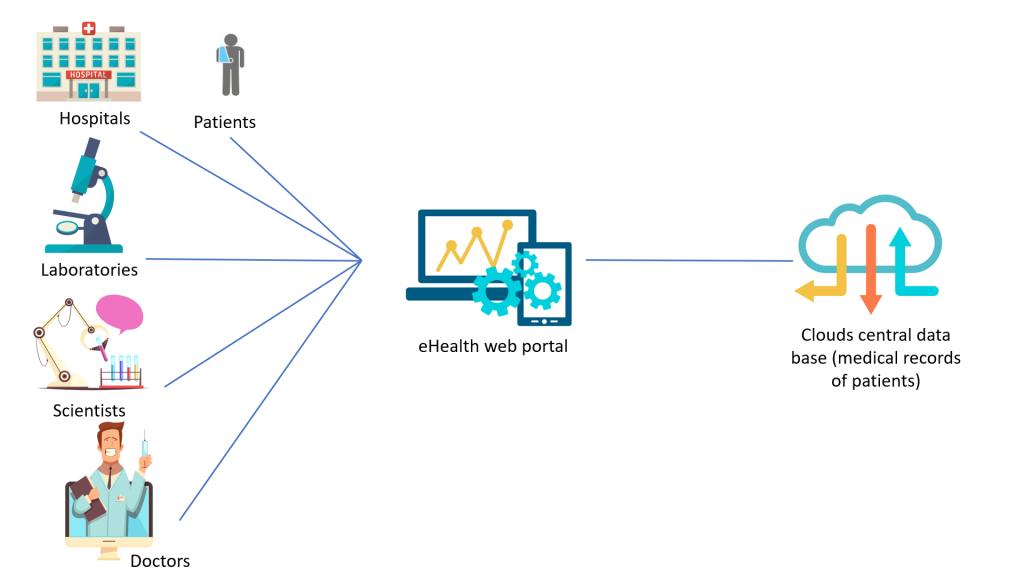
The eHealth system is a newly developed space that contains electronic processes and communications. EHR or EMR is a compilation of patient health data. EHR or EMR is digital information that contains data, diagrams, patient medical information, medications, hospital or clinic reports, radiology photographs, billing information, and other sensitive patient information. Cloud computing offers the cost of effectively storing, processing, and updating data with efficiency and quality.
Cloud computing offers the advantage of access to hosted services from multiple locations with a number of multiple users. eHealth systems promise faster, robust, and sought-after access to medical records, fewer medical regulations, and improved health care quality, but equally reflect patient privacy, improper authorization, and misuse of EHR data. Cloud security and privacy are critical requirements when sharing or accessing patient data.
There are many ways to achieve the use of the cloud platform. A few of them are as mentioned below.
1. Public Cloud: A cloud service provider will make resources available to private and public users via the Internet for free on-going or demand purposes that allow clients to pay only for what they use without lower fees. Instead of purchasing a physical server and switching, the company can purchase a virtual server and network. A virtual server can be turned on or off for minutes and can be accessed anywhere. The public cloud relies on a customized environment to provide corporate infrastructure expansion, allowing the company to host certain aspects of its infra structure and services on virtual and identifiable third-party servers. Public cloud service providers have unique capabilities, and they offer excellent types of services and price models. Companies considering migration have carefully considered their options when it comes to choosing a provider, especially if they are to be terminated in a long-term contract. Careful planning can help reduce costs in monthly payments for cloud services, but organizations with unexpected age of the usage community may find it difficult to avoid spending large sums on public cloud services under unforeseen use.
2. Independent cloud: A public cloud is an infrastructure that uses a single organization and defines a single network or datacenter that provides services hosted to a specific group of people. The public cloud service offers easy access. Although a private cloud is less expensive than using a public cloud, it is not easily measured. The development or growth of infrastructure will require the purchase of additional equipment. Similarly, when the
need for a private cloud decreases, expensive resources and equipment are misused.
3. Hybrid Cloud: A cloud infrastructure that is a combination of two or more clouds that can be a combination of a private, or public cloud. In hybrid cloud infrastructure, the organization provides and manages resources within the private data center and provides outsourced services such as VMware that works with Fortinet Networks to provide hybrid cloud infrastructure to businesses to lighten their private cloud to remote servers while the public cloud is secure.
The Hybrid model cloud is usually an excellent deal for those looking at a public cloud vs. private cloud. Hybrid Cloud refers to any integration of personal and public cloud solutions. The hybrid cloud environment allows organizations to take advantage of both types of cloud platforms and choose which cloud will provide the specific data needs.
For example, the hybrid cloud provides another way to store sensitive data company information that can provide services through the public cloud while maintaining sensitive configuration in the private cloud.
Advantages of Cloud-Based eHealth Systems
The more a healthcare center connects system information to a global computer network such as the Internet, the more it opens up access from around the world and facilitates data leaks. The need for an electronic health record should be protected from illegal users who may misuse this for a variety of purposes. Identity-based encryption is one of the best security solutions to protect eHealth record data. The algorithm deals with problems found in common cryptographic techniques using any thread as a public key. The system can enhance the security of health records by adding authentication procedures to three connected servers. In this system, communication between three servers uses encrypted data using IBE, so that each server can perform the encryption and decryption process during the data exchange. Only servers with IDs can access and extract health record data. Currently, test results show performance relative to the speed of the algorithm used in the system.
As discussed, and referred to in article, Cloud Storage is a computer model that stores data on the Internet or in the cloud. Cloud storage is delivered according to demand and capacity and costs that will leave the customer investing and managing their data storage infrastructure. This provides speed, scale, and durability.
Below are some of the general advantages of cloud computing; Ease of access using a Web Browser with integrated Single-Sign-On (SSO).
- No requirement for VPN to access Cross Sites or Networks.
- Simplified Management and On-demand Scalability.
- No Overhead Cost to maintain the physical infrastructure.
- No Hardware post warranty charges for the physical infrastructure.
- No Power Consumption.
One of the major schemes in healthcare systems is attribute-based encryption for data.
Encryption provides high-class access control for every user and revocation, scalability, dynamic user management, and traceability. Users have high-grade login access which can be integrated with 2FA authentication as well as OTP for every access. Similarly, users’ access can be revoked from a centralized management console at any point in time by the administrator. The most important advantage is that every access is recorded and can be traced, and clipping implemented for each session. Privileged Access Management (PAM) is one of the best technologies which can be used if there are many subsystems that
a user needs to access at a single point in time. Another scheme used in health care in cloud computing is robust and secure access control which resolves single-point performance bottle-neck problems. This solves the majority of the security access control issues as the certificate needs to be trusted and issued from a certified hosting platform. As we all know, the main disadvantage