
Articles
Clinical decision support system (2)
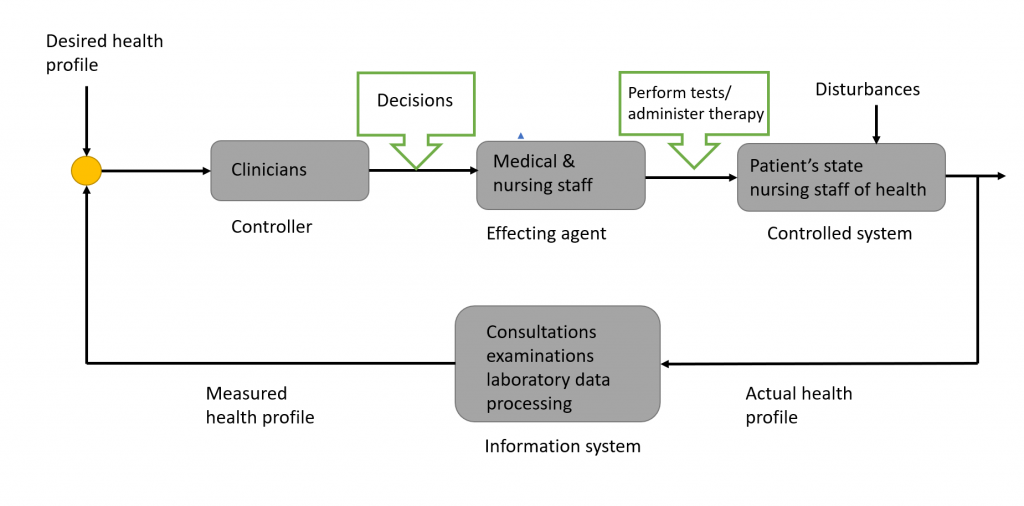
The clinical decision support system receives data and information regarding the state of the patient from EHR, and by comparing these current data with past data and a favorite state of the patient, using related models, determines an appropriate decision. This decision is then execute, for example, by other members of the health care team. The result is a change in some attributes of the patient state, either in terms of state of knowledge diagnostically in response to test or r, or state of well-being following therapeutic intervention. Feedback, via appropriate information systems, enables the decision maker to review or update the decision as necessary.
Significance Needs Decision Support
decision support system is to be found at all levels of health care system, At the strategic level, policy is making investment decisions relating to new health care facilities and provision, including those relating to public health. Health care professionals, both clinicians and joined health professionals, are making diagnostic and therapeutic decisions so as best to manage the individual patient.
Decision Support Tools
Software programs written specifically to aid the decision-making process; these tools have different source of the knowledge from the following:
- Observations: Observing the domain experts as they carry out their duties. This approach can often result in the discovery of new knowledge.
- Academic knowledge: Printed information from published material in academic publications such as journals and conference proceedings are a useful source of knowledge. Care should always be given to ensure the accuracy of any published information, particularly from unreviewed sources.
- Experimental: Results from conducting tests and trials. This is a useful method of collecting knowledge as control is maintained; however, costs and time considerations, in terms of both ethical approvals and collecting a suitable number of subjects, should not be underestimated.
Aspects of knowledge acquisition include the following:
- Elicitation: The discovery of aspects of the CDSS domain that are not immediately obvious or a detail so commonly part of the domain process that the experts do not consider mentioning it, yet it has an important role in a CDSS.
- Domain experts: The knowledge from experts is a vital ingredient of a CDSS. This can be obtained from interviews, questionnaires, or observations. A nonexpert can play a useful role in extracting knowledge from experts by asking questions to establish the real need for each procedure.
- Information to users: Techniques from knowledge engineering and knowledge management can be used to ensure that the final output is of value to the user of a CDSS.
Knowledge representation is one of the key elements of a CDSS system. It is the method by which collected information is stored and presented to the CDSS. including the following:
- Heuristic systems: These are less well deWned and can be based on experimental or critical knowledge. A heuristic system can be considered as the knowledge of good practice, good judgment, or plausible reasoning.
- Artificial neural networks: Simple models of the human brain can be used to model knowledge. The strength of these tools lies in their ability to be trained for specific domains.
- Expert systems: A series of if, then rules can be used to define a knowledge base. An inference engine is then used to navigate the knowledge base using defined rules, such as forward to backward chaining.
- Computer languages: Formal, specialized computer languages, such as PROLOG, that use logic statements to define and navigate a knowledge base.
Maryam Ghalandari